
Your Ai Agent Can Now Ask to Pay. KAELUM Agent Payments K402.
How KAELUM Agent Payments (K402) brings the web's forgotten payment code to life, inside a governed Commerce Currency.
The Buyer is Changing. The Payment Layer has not.
Ai agents are starting to do real work for us. They research, compare, book and fetch. Before long, a meaningful share of the requests hitting any website or API will come from software acting for a person, not from the person themselves.
That raises a question the payment industry has barely started to answer: what happens when an agent reaches something that costs money?
Today the honest answer is that it stops. Card checkouts were built for a human with a card in hand, a form to fill in and a button to press. API access was built around subscriptions, keys and monthly invoices agreed in advance. Neither fits an agent that needs one dataset, one report or one API call, right now, for someone it works for.
The obvious fix, handing an agent a card number, is the wrong one. It gives software open-ended spending power with no limits, no context and no one checking what it buys.
The web has had an answer waiting since its earliest days. KAELUM has now built it.
Why this Matters now
The way money moves is being rebuilt on both sides of the Channel, and the signals are coming from the top.
- In February 2026 the CEO of the European Payments Initiative, Martina Weimert, told the Financial Times that Europe is "highly dependent on international [payment] solutions" and that "we need action urgently" (PYMNTS).
- In August 2026 the UK government set out plans to give the Bank of England a new secondary objective to support innovation in payment systems and emerging forms of digital money, through amendments to the Financial Services and Markets Bill (Lewis Silkin).
- In September 2026 the UK Payments Delivery Company opened a fundraising of around £50 million, backed by 19 firms including the four largest UK high street banks, to build a domestic alternative to the card networks, funded through 2028 (Fintech Futures).
Those efforts are about how people pay. The next wave is about how software pays on people's behalf. If the payment layer is being rebuilt anyway, it should be rebuilt for agents as well as humans, and with the human firmly in control.
What K402 is
When the web's founders wrote the rules for how servers answer requests, they reserved one status code for a future they could see but could not yet build: 402 Payment Required. For decades it sat almost unused, because there was no simple, safe way for a machine to pay.
Agents change that, and the wider industry has started to put 402 to work. KAELUM Agent Payments, which we call K402, is our own protocol built on that standard code. K for KAELUM, 402 for the web's payment signal.
K402 lets an Ai agent pay a KAELUM merchant or creator per request, in KAE, the KAELUM commerce currency. It is live on kaelum.app today, and it rests on three principles:
- The agent never holds money. It can only ask to pay from its user's KAELUM account.
- The person decides. Every K402 payment today is approved by the account holder, with a passkey for larger amounts.
- Settlement stays inside KAELUM. KAE moves between KAELUM accounts through the same checkout, fees and checks as every other KAELUM payment. No blockchain, no wallets, no exchange.
Crypto is powered by Blockchain. KAELUM is powered by Ai. K402 is what that looks like when the buyer is software.
How it Works
A K402 payment takes six steps, and the person stays in the loop at the only one that matters.
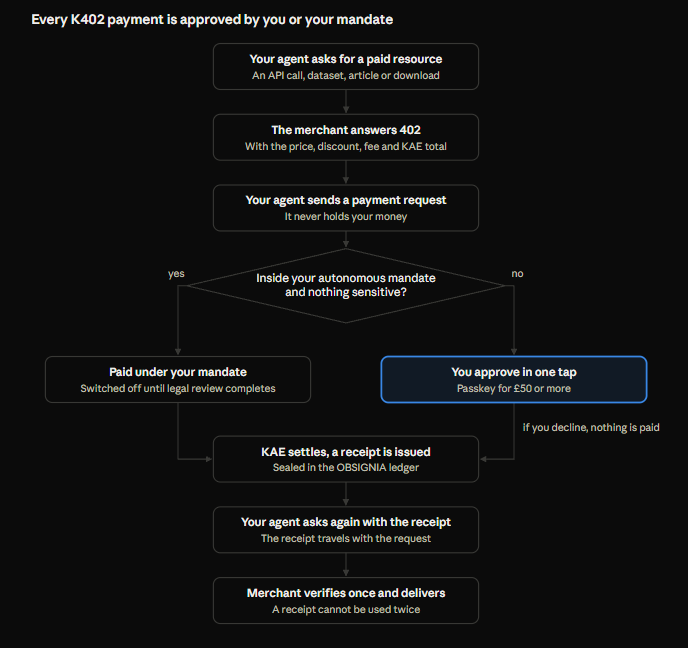
- The agent asks for something priced. An API call, a dataset, an article or a download at a KAELUM merchant or creator.
- The merchant answers 402. Its server replies with a K402 challenge: the price, the merchant's KAELUM discount, the 4.5% platform fee and the total in KAE.
- The agent sends a payment request. It passes the challenge to KAELUM for the person it works for. Claude can do this today through the KAELUM connector.
- The person approves. The request appears on the Agent Payments page and in their K.A.T.E. chat, with what is being bought, from whom, and why K.A.T.E. is asking. One tap approves it; larger amounts need a passkey. Declining costs nothing.
- KAE settles and a receipt is issued. The merchant is credited, the payment is sealed in KAELUM's tamper-evident OBSIGNIA ledger, and the agent receives a signed K402 receipt.
- The merchant verifies and serves. The agent retries its request with the receipt. The merchant checks it with KAELUM, once, and delivers.
Here is what a £1.00 request looks like, taken from a live test on kaelum.app:
| GBP | KAE | |
|---|---|---|
| Price of the resource | 1.00 | |
| Merchant's KAELUM discount (6%) | -0.06 | |
| Merchant receives | 0.94 | 4.70 |
| Platform fee (4.5%) | 0.04 | 0.20 |
| Customer pays | 0.98 | 4.90 |
The customer pays less than the listed price because KAELUM merchants give a discount of at least 6% when people spend KAE. KAE is fixed at £0.20, so the figures are as easy to read as pounds.
K.A.T.E. Governs the Rails. You Govern the Spend.
The fear around agentic payments is simple: software spending money nobody approved. K402 is designed the other way round. Ai is the guardrail, not the risk.
- You set the permission level. Observe means agents cannot pay at all. Recommend, the default, means every payment waits for you.
- Limits you choose. Agent mandates carry per-payment and period ceilings, named merchants and categories, and an expiry date. They are granted with a passkey and can be suspended or revoked in one tap.
- Sensitive payments always come to you. A first payment to a new merchant, an unusually large amount, or anything above the passkey threshold is never settled without you.
- Every payment is screened. SENTINEL, KAELUM's compliance check, screens the payer before any KAE moves. If anything looks wrong, the payment is held.
- Every payment leaves evidence. A transaction record, a tamper-evident ledger entry and, where a mandate is involved, a hash-chained record of what the agent asked for and why.
Autonomous agent payment, where an agent pays inside a mandate without asking each time, is built into K402. It stays switched off until KAELUM's independent legal review is complete. Until then, every K402 payment has a human approval behind it.
And you do not need to visit a separate screen to stay in control. Ask your K.A.T.E. agent "any agent payments waiting?" and it shows each request with Approve and Decline buttons, right in the chat.
For Merchants and Creators: a new kind of Customer
If agents become buyers, every business with something digital to sell needs a way to charge them. K402 gives KAELUM merchants and creators that way in minutes, with no new payment provider and no SDK.
- Price anything per request. An API call, a product feed, a research report, a premium article, a design file. Set the price and your KAELUM discount, from 6% to 18%, on the Agent Payments page.
- Two calls on your server. When a request arrives without a receipt, ask KAELUM for a challenge and answer 402. When the agent comes back with a receipt, ask KAELUM to verify it, then serve. KAELUM gives you the snippet to copy.
- No fee on what you receive. The payer covers the 4.5% platform fee. You receive the full discounted amount as KAE you can redeem, subject to KAELUM's standard redemption terms.
- Receipts that cannot be replayed. Each receipt is signed, short-lived and, by default, valid once.
- Every payer is governed. You are paid only by KAELUM accounts whose owners have approved the payment.
For creators this opens something new: selling a single piece of work to an agent doing research for someone, without a subscription, a paywall login or an invoice.
How K402 Compares
Agents need a way to pay that is made for them, not borrowed from a human checkout.
| Card checkout | API subscription | KAELUM K402 | |
|---|---|---|---|
| Made for | A person at a form | A developer, agreed in advance | An agent acting for a person |
| Pay per request | No | No, monthly or prepaid | Yes, from £0.20 |
| Agent holds payment details | Yes, if given a card | Yes, an API key | No, never |
| Person approves each payment | No, once given a card | No | Yes, with passkey for larger amounts |
| Spending limits and expiry | Card limit only | Plan limit only | Per payment, per period, per merchant |
| Customer discount | No | No | At least 6% |
| Chargebacks for the merchant | Yes | Possible | No card chargebacks, settled in KAE |
| Proof of what was paid and why | Statement line | Invoice | Signed receipt and tamper-evident ledger entry |
Built inside a Closed Loop
K402 changes how a payment is requested, not what KAE is. KAE is a fixed-price commerce currency, issued at £0.20 per unit and spent with participating merchants and creators. It is not an investment and it does not change in value.
KAELUM is pre-launch and is working towards the appropriate regulatory permissions before it takes any customer funds. Top-ups run on European Open Banking through TrueLayer, with cards available as an optional route.
What comes next
The web reserved a code for payments over thirty years ago. Agents are finally giving it a reason to exist. The question is not whether software will pay for things on our behalf. It is whether that happens on rails that were designed for it, with people in charge.
K402 is our answer, and it is live. KAELUM is in a controlled onboarding phase, and 8T Clothing is our first verified live merchant. Next, we are bringing K402 to more merchants and creators with digital products, publishing the protocol for developers, and preparing the path to governed autonomous payments once our legal review is complete.
If you build APIs, publish research or sell digital work, and you want your next customer to be an agent, talk to us at kaelum.app.
Frequently Asked Questions
What is KAELUM Agent Payments (K402)?
K402 is KAELUM's protocol for Ai agents to pay KAELUM merchants and creators per request in KAE, using the web's standard HTTP 402 Payment Required code. The agent requests a payment, the account holder approves it, and the agent receives a signed receipt.
Can an Ai Agent spend my money without asking?
No. An agent never holds your money or payment details; it can only ask. Today every K402 payment needs your approval, and larger amounts need your passkey.
Is K402 a cryptocurrency or blockchain protocol?
No. K402 settles in KAE, KAELUM's commerce currency, between KAELUM accounts. There is no blockchain, no wallet and no exchange involved.
What does a K402 Payment cost?
The merchant gives at least 6% off the price, and the payer pays KAELUM's 4.5% platform fee on the discounted amount. A £1.00 resource costs the payer 4.90 KAE (£0.98).
How do I approve Agent Payments?
On the Agent Payments (K402) page at kaelum.app, or by asking your K.A.T.E. agent "any agent payments waiting?" and tapping Approve or Decline in the chat.
How can my Business Accept K402 Payments?
Create a K402 resource on the Agent Payments page, set its price and discount, and add two calls to your server: one to issue the 402 challenge and one to verify the receipt. Visit kaelum.app to join as a merchant or creator.
Crypto is powered by Blockchain. KAELUM is powered by Ai.
KAELUM Technologies Ltd is registered in England and Wales (Company No. 16681154). KAE is a closed-loop commerce currency fixed at £0.20 per unit. It is not a crypto asset, security, deposit or investment instrument, does not appreciate in value, pays no interest or return, and cannot be traded. Only KAE earned through commerce by merchants and creators may be redeemed for fiat, subject to fees and limits. KAELUM is pre-launch and is working towards the appropriate regulatory permissions before it takes any customer funds. Autonomous agent payments are built but not switched on. Third-party and public-body information is drawn from published sources as of October 2026 and may change, and its inclusion does not imply endorsement of KAELUM by any named organisation. This article is for informational purposes only and does not constitute financial, legal or investment advice, or an invitation or inducement to invest.