
What the New Payment Architecture Looks Like: KAELUM
5 connected Layers, 1 Accountable Intelligence, and why the answer is not another Gateway, another Blockchain or another Ai Tool.
For 40 years, payments have been built one problem at a time. A gateway to accept the payment. A processor to process it. A network to move the instruction. A fraud engine, a compliance system, a routing engine, a settlement system and, at the end of the chain, a reconciliation team matching records that never quite agree.
Each layer solves a real problem. Each one also adds a handoff, a fee and another company in the middle. And in Europe, most of those layers lead back to the same two American networks: Visa and Mastercard handled around 61% of euro area card payments in 2022, according to the ECB, and up to 95% of UK card transactions run on them.
The pressure to change is now coming from the top. The CEO of the European Payments Initiative has called publicly for alternatives to the two schemes, and ECB President Christine Lagarde has echoed the call. In the UK, the government is giving the Bank of England a statutory secondary objective to support innovation in payments, and the UK Payments Delivery Company launched a £50M raise in September 2026, backed by the four largest UK banks, to build a domestic account-to-account alternative.
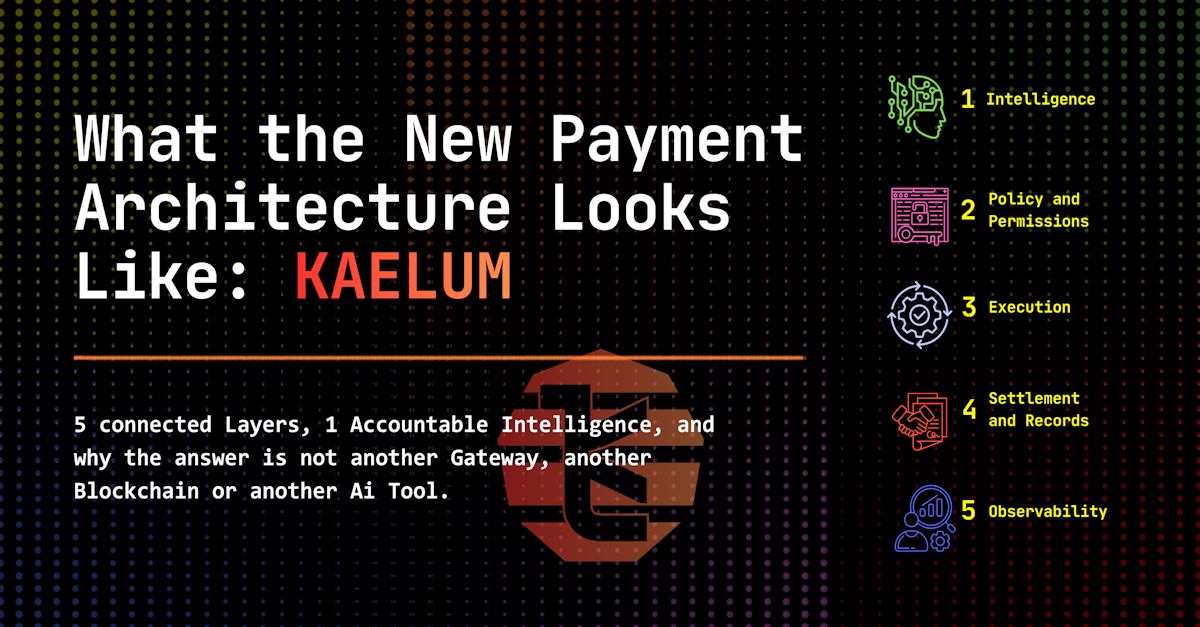
Sujal N Shah's Future of Payments Series Episode 9 on LinkedIn put the real question well: if every layer works, who is responsible for making the whole system work as one? His answer was 5 connected layers: Intelligence, Policy and Permissions, Execution, Settlement and Records, and Observability.
We agree with the shape. KAELUM is already built on it, and every layer has one governor: K.A.T.E., the Ai COO, a multi-instance deployment of Claude that acts as the Ai Chief Operating Officer of the platform. Here is what each layer looks like when it is designed as part of one system from day one.
1. Intelligence: Ai Advises, Rules Decide
The intelligence layer chooses how money moves: which rail, at what cost, with what risk. The common assumption is that Ai should make that call. We think that is the wrong place for a model.
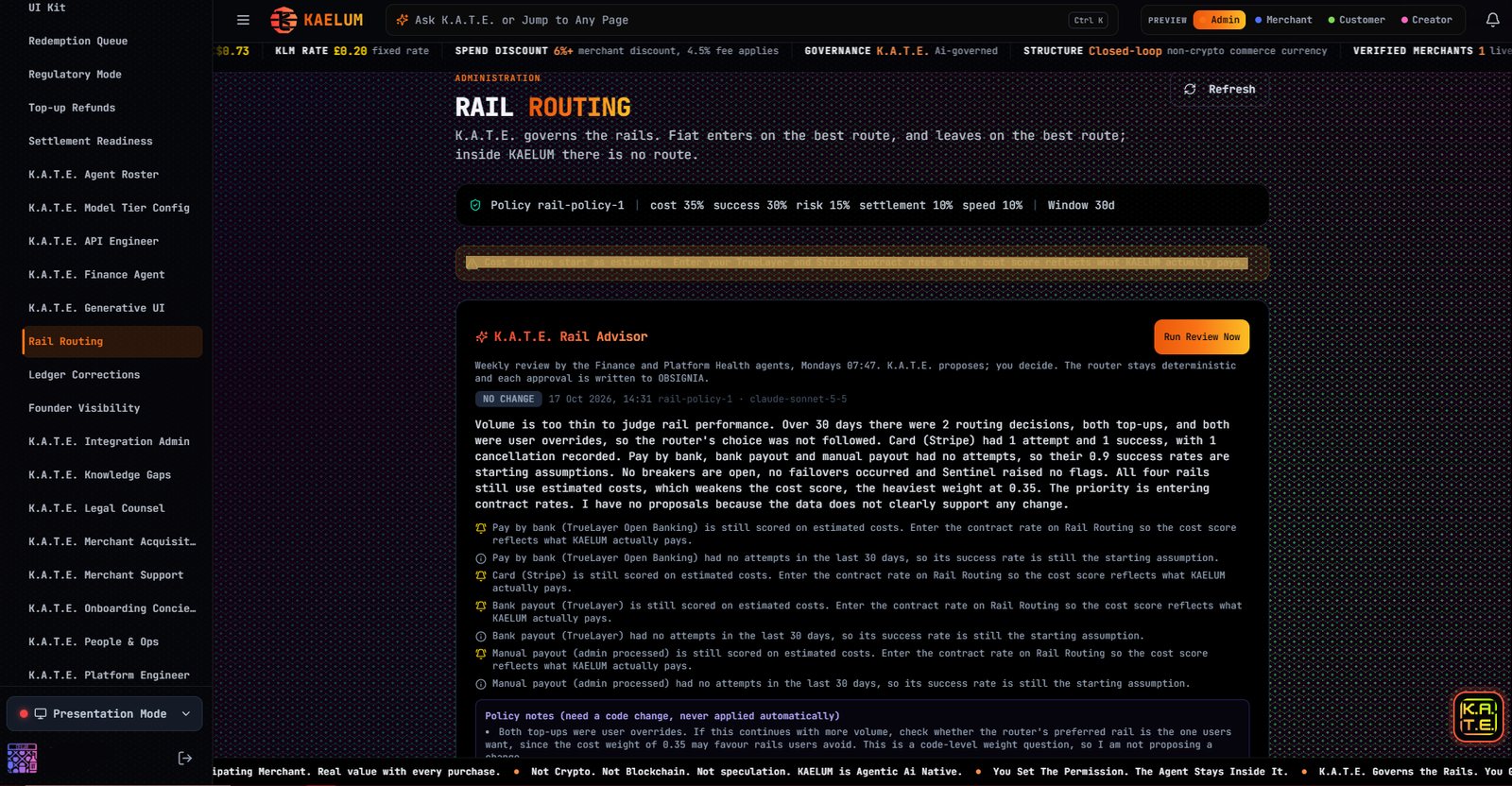
In KAELUM, every top-up and every payout is routed by a deterministic rail router. It scores each available rail on five factors: cost, success rate, risk, settlement time and speed to the user. The same inputs always produce the same route, and every decision is logged with its scores and its reason, so it can be explained to a merchant, a partner bank or a regulator and reproduced exactly. If a rail fails, the router switches to the backup automatically. If a rail keeps failing, a circuit breaker takes it out of service.
Where Ai earns its place is above the router, not inside it. Every week the K.A.T.E. Rail Advisor, run by the Finance and Platform Health agents, reviews thirty days of rail performance: which rails succeeded, how long payments really took, where customers overrode the recommendation. It proposes specific changes to the settings the router scores on, with its reasoning. Nothing changes until a person approves it.
That is continuous learning with a human gate. The intelligence improves every week; the money path stays predictable every second.
2. Policy and Permissions: K.A.T.E. Governs the Rails, you Govern the Spend
The policy layer decides what is allowed, who can take part and when a payment may proceed. As Ai agents begin to buy on people's behalf, this becomes the most important layer in the stack, because an agent with a card number and no rules is a liability.
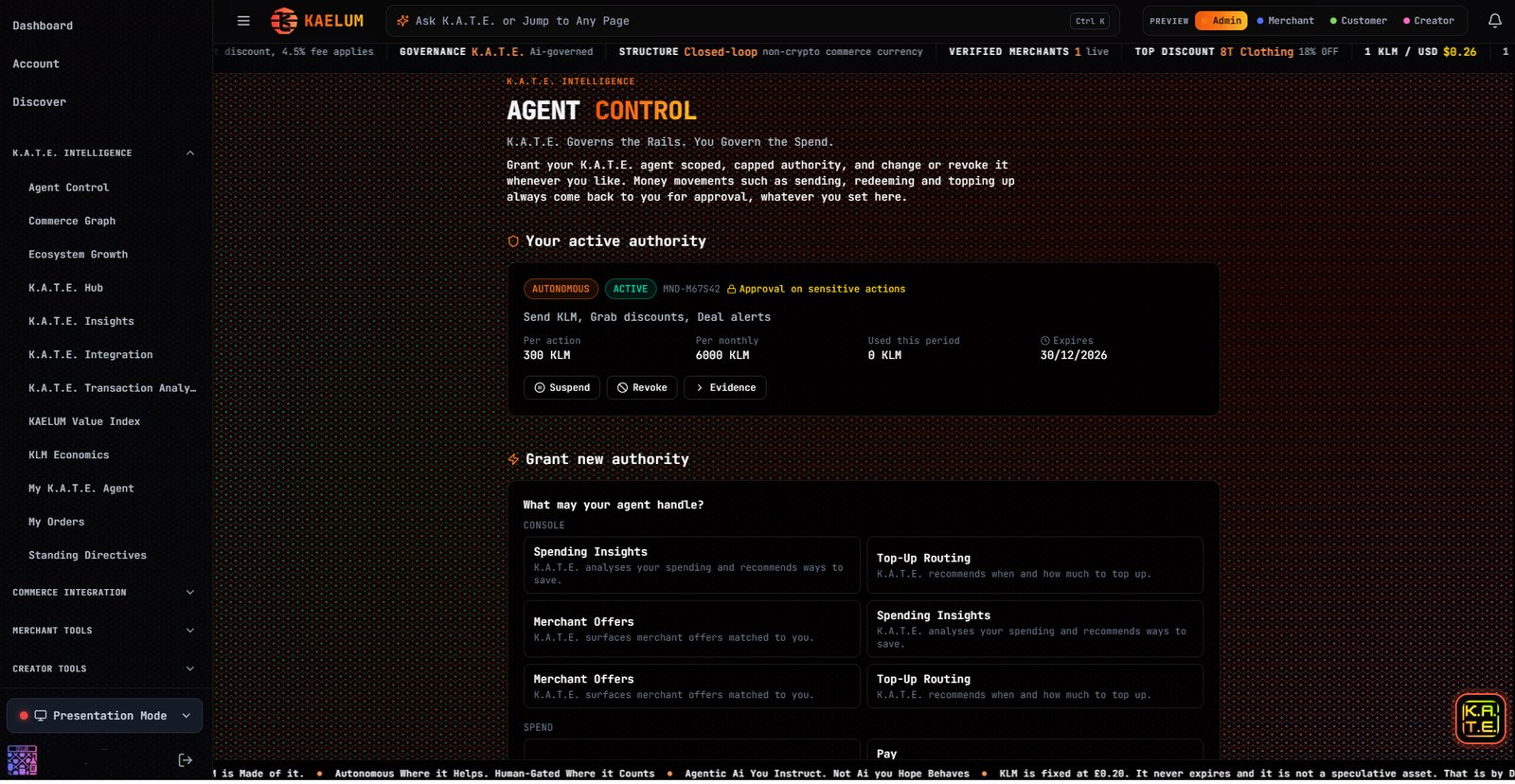
KAELUM puts the person in charge of every agent that acts for them. In Agent Control, a customer grants an agent authority, sets a spending cap, and can suspend or revoke it at any moment, with every change kept as evidence. For each capability, they choose how far K.A.T.E. may go: observe, recommend, or act autonomously on tasks that move no money. Spending is different. An agent purchase is approved by the customer with one tap, confirmed with a passkey above a threshold, and screened by SENTINEL, the KAELUM fraud and scam engine, before any KAE moves.
The same principle runs through the platform's own controls. Redemptions for merchants, creators and customers each have their own switch, enforced on the server. Peer-to-peer transfers can be paused platform-wide in one action. Sensitive actions, account suspensions and user-facing communications pass human approval gates before they happen.
Our line for this layer is simple: K.A.T.E. governs the rails. You govern the spend.
3. Execution: Fiat at the Edges, no Rail in the middle
The execution layer carries the authorised instruction over the right rail. Most architectures try to make every hop cheaper. KAELUM removes most of the hops.
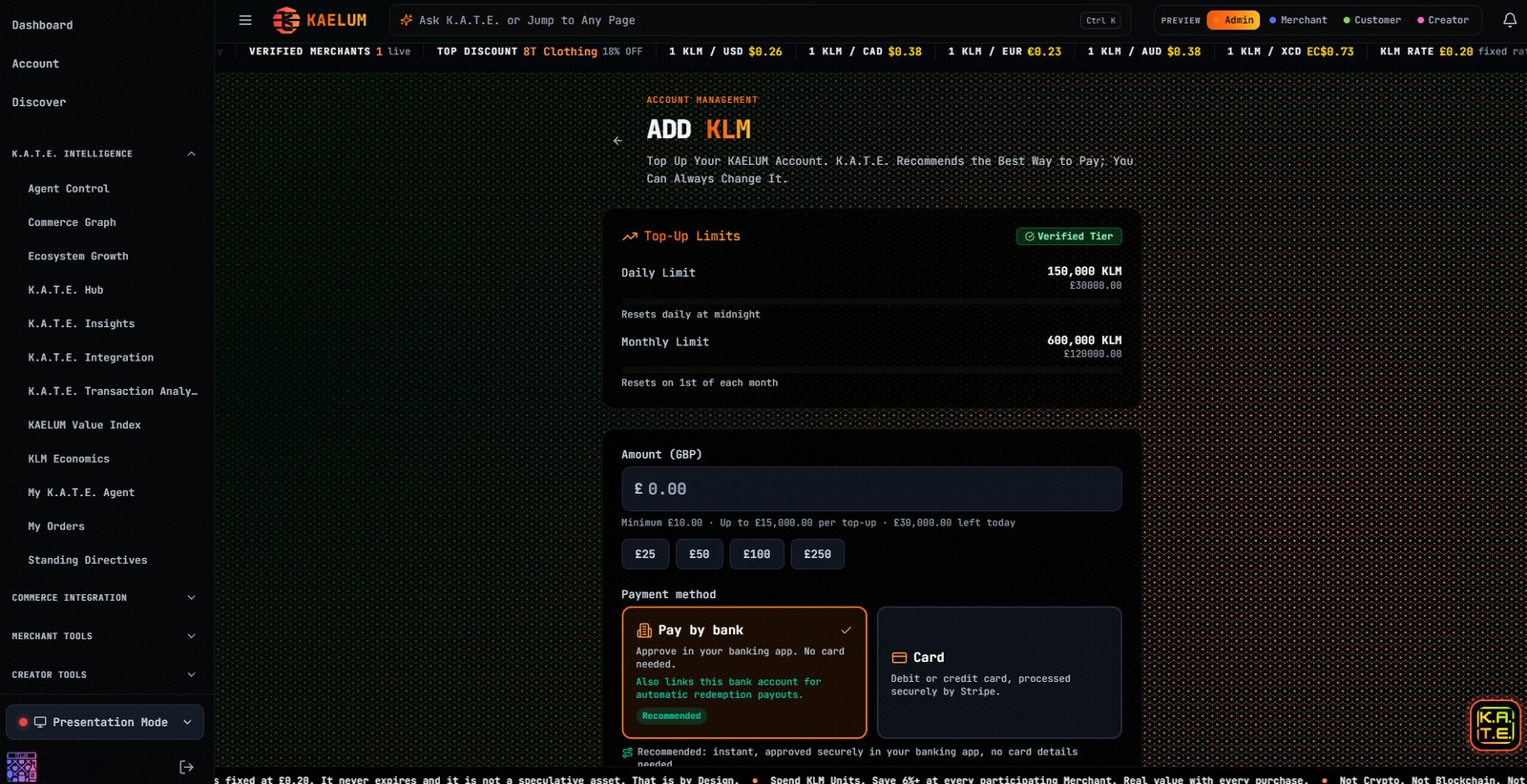
Money meets a payment rail only twice: when it comes in and when it goes out. Customers top up through KAELUM Open Pay, which runs on TrueLayer Open Banking and is approved in their own banking app, or by card through Stripe as a secondary option. Merchants and creators redeem KAE they have earned from sales, paid by TrueLayer payout to the bank account they linked during onboarding, with a manual payout as the fallback if the automated rail is unavailable.
Between those two edges there is no rail at all. KAELUM is pre-launch and is working towards the appropriate regulatory permissions before it takes any customer funds. A payment between a customer and a merchant is not handed to a gateway, a processor and a card network. It is one governed movement, recorded once.
That is where the value comes from. Customers receive a 6%+ discount from participating merchants when they spend KAE (a 4.5% platform transaction fee applies), and merchants are not charged on the payments they receive.
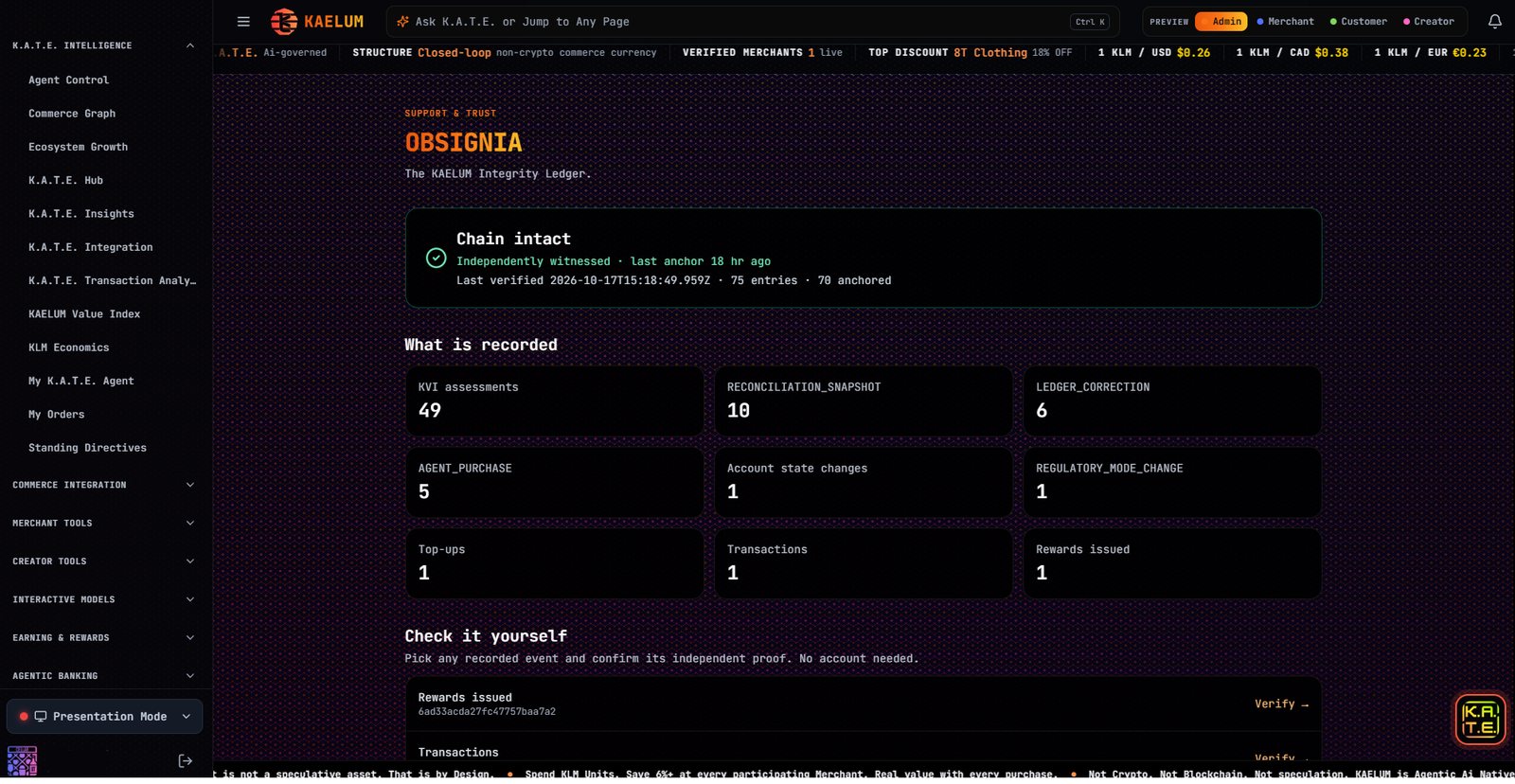
4. Settlement and Records: Proof without a Blockchain
The settlement layer finalises the transaction and keeps the record. The usual promise is that shared ledgers and tokenisation will reduce reconciliation. KAELUM gets the benefit without the chain.
Every completed payment, transfer, top-up, refund and redemption on KAELUM is written to OBSIGNIA, the KAELUM integrity ledger. Each entry is hash-chained to the one before it, so altering any past record breaks every record after it. Entries are grouped under a Merkle root and that root is timestamped by an independent RFC 3161 timestamp authority, so anyone can prove a record existed, unaltered, at a given moment without having to trust KAELUM. Any participant can check a record at kaelum.app/verify.
Around the ledger sit the controls a finance team expects. A reconciliation snapshot runs every morning, comparing the fiat position with the KAE outstanding and writing its own result to OBSIGNIA. Corrections are made as new approved entries, never by editing the past. Statements export every transaction on one line, with gross, discount, fee, net, bank reference, payout status and OBSIGNIA sequence, in CSV or in a format structured to ISO 20022 camt.053 for accounting tools.
Reconciliation becomes a check, not a project, because the record was right when it was written.
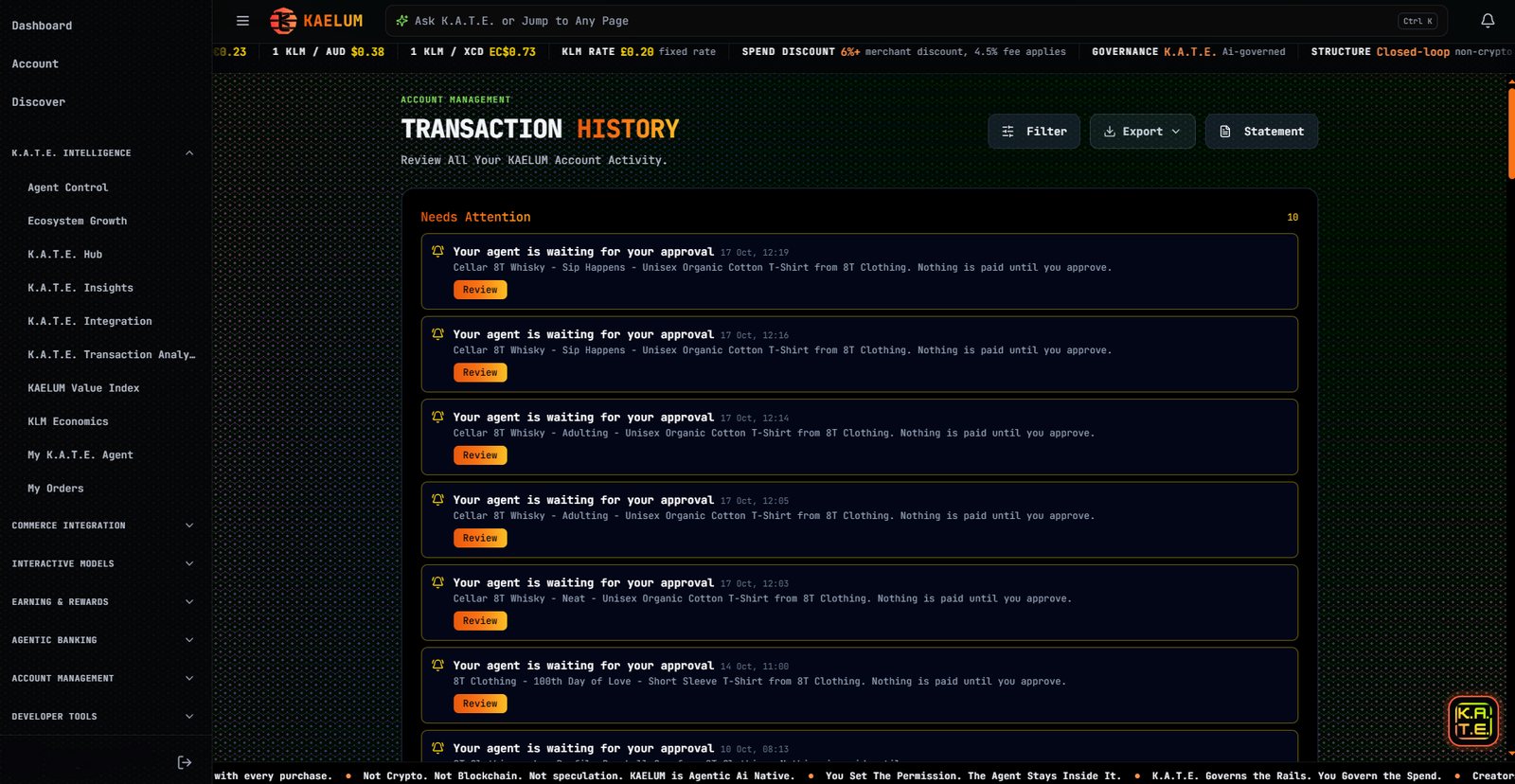
5. Observability: Everyone sees what the Operator sees
The observability layer gives every participant visibility into status, exceptions, costs and outcomes. In most payment systems, that visibility belongs to the operator. The customer gets a line on a statement; the merchant gets a settlement report days later.
In KAELUM, every transaction opens into a timeline that shows the same story the operations team sees, in plain English:
- What happened, step by step: initiated, safety checks, the person's own approval where one was needed, the rail chosen, completed or paid out, and recorded on OBSIGNIA.
- Why it moved the way it did: the rail the router chose and the reason, for example lower cost and lower risk than the alternative, or a note that KAELUM switched to the backup rail automatically.
- What it cost, line by line: price, merchant discount, the 4.5% platform transaction fee and, for payouts, the redemption fee and the amount paid to the bank.
- The proof: the OBSIGNIA entry number with a one-tap Verify.
Merchants and Creators also get a Needs Attention panel that surfaces anything held, failed, waiting for them or still in progress, such as a redemption under review with its expected time, or an order that was paid but has not reached their own store. Behind that, the operations side runs on the same records: rail decisions, agent activity, the K.A.T.E. audit log and the integrity chain status.
When something goes wrong, the participant knows before they have to ask.
One System, One Governor
The objective was never to remove every intermediary. Banks, Open Banking providers and timestamp authorities do essential work, and KAELUM relies on them. The objective is to remove the handoffs that add cost and no value, and to make the remaining layers answer to a single, accountable intelligence.
That is the role of K.A.T.E., whose 21 specialised Claude agents run compliance, fraud and scam detection, finance, platform health and support, with human approval gates on every sensitive action. The router decides by rules. The person decides on the spend. The ledger proves what happened. Everyone can see it.
KAELUM is built and in pre-launch testing. K.A.T.E. is operational, and 8T Clothing is our first verified merchant integration. We are working to bring the next Merchants, Creators and Customers onto the network. The digital euro is 2029 at the earliest and Wero is still scaling. The architecture this series describes does not need you to wait for either.
If you are a Merchant who wants to accept KAE, a Creator who wants to monetise an audience, a Customer who wants to save on every purchase or an investor who sees where payments are going, start at kaelum.app or write to info@kaelumtechnologies.com.
Crypto is powered by Blockchain. KAELUM is powered by Ai.
See Sujal N Shah's post here: lnkd.in/p/eBXH826G
KAELUM Technologies Ltd is registered in England and Wales (Company No. 16681154). KAE is a closed-loop commerce currency fixed at £0.20 per unit. It is not a crypto asset, security, deposit or investment instrument, does not appreciate in value, pays no interest or return, and cannot be traded. Only KAE earned through commerce by merchants and creators may be redeemed for fiat, subject to fees and limits.
KAELUM is pre-launch and is working towards the appropriate regulatory permissions before it takes any customer funds. Third-party and market information is drawn from published sources as of October 2026 and may change, and its inclusion does not imply endorsement of KAELUM by any named organisation. This article is for informational purposes only and does not constitute financial, legal or investment advice, or an invitation or inducement to invest.