
The Currency Ai Agents will use to make Payments
Machines are learning to Shop. Money has to learn to be Governed. Your next customer might not be human. Ai agents are moving from assistants that answer questions to participants that act, and KAELUM is built to be the currency they pay with.
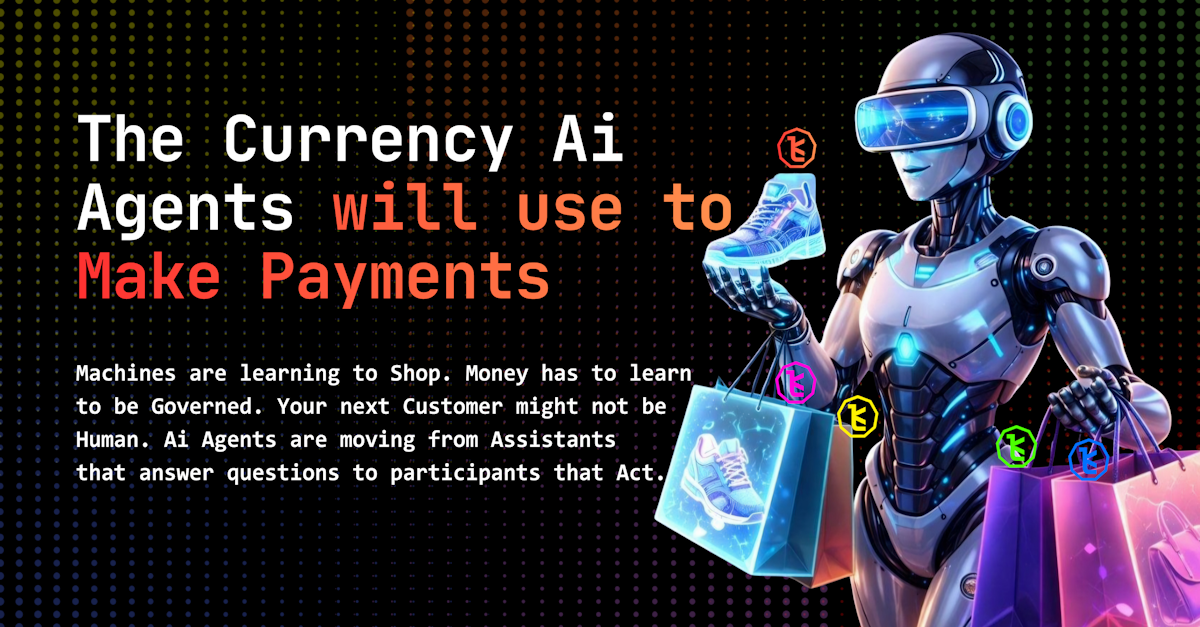
Machines are learning to Shop. Money has to learn to be Governed.
Your next customer might not be human.
Ai agents are moving from assistants that answer questions to participants that act. They compare products, negotiate terms, place orders and settle bills on behalf of the people and businesses they serve. The question nobody has fully answered is simple: when an Ai agent pays, what does it pay with, and who decides whether the money moves?
KAELUM is built to answer that question. It is an Ai-native, closed-loop digital commerce currency, governed by Ai and controlled by people, designed for the moment commerce stops being purely human.
Payment Rails were Built for Humans
Today's payment infrastructure assumes a person at the till. A cardholder taps, a bank approves, and fraud checks look for behaviour that seems human. Agents break every one of those assumptions.
- Card networks charge every transaction. Up to 95% of UK card transactions run on Visa and Mastercard. Every agent purchase routed through them carries the same interchange, scheme and processing fees as a human one, multiplied across millions of small, frequent transactions.
- Chargebacks assume a human dispute. When an agent buys something its owner did not expect, the existing system has no clean answer for who authorised what.
- Fraud models flag machines. Systems tuned to catch bots treat legitimate agents as threats, while bad actors learn to look like agents.
- Control is all or nothing. Hand an agent a card number and it can spend like you. There is no native layer that says what an agent may buy, from whom, and up to what limit.
Agentic commerce needs a currency that was designed with these problems in mind, not one retrofitted after the fact.
Europe is already asking for an Alternative
The demand for new payment infrastructure is no longer theoretical. It is coming from the institutions that run the system.
- In February 2026, European Payments Initiative CEO Martina Weimert called urgently for alternatives to Visa and Mastercard (Financial Times), and ECB President Christine Lagarde echoed the call.
- The UK government is giving the Bank of England a statutory secondary objective to support innovation in payments and new forms of digital currency, through the Financial Services and Markets Bill (City AM, 27 August 2026).
- On 15 September 2026, the UK Payments Delivery Company launched a £50M raise backed by 19 firms, including the four largest UK banks, to build a domestic account-to-account alternative to the card networks (Sky News, City AM).
Visa and Mastercard handled around 61% of euro area card payments in 2022 (ECB), and 13 euro area countries have no national card scheme. Wero is still scaling country by country, and the digital euro is 2029 at the earliest. None of these were designed with Ai agents as the primary customer.
These are independent market signals, not endorsements of KAELUM. They show where the system is heading.
What KAELUM is
KAELUM is an Ai-native, closed-loop digital commerce currency platform for three participants: Customers, Creators and Merchants. Its currency is KAE, fixed at £0.20 per unit. KAE is issued only when it is paid for at that price, and it is spent with KAELUM merchants and creators. That is what closed loop means here: a description of how KAE is used.
Every transaction is governed by K.A.T.E., the Ai engine at the centre of the platform, powered by Claude from Anthropic. K.A.T.E. coordinates 21 specialised Ai agents covering onboarding, merchant support, transaction insights, fraud and scam detection, cybersecurity and compliance.
For an Ai agent, the flow is straightforward:
- The account holder sets what the agent may do: observe, recommend or act, capability by capability.
- The agent finds a product and proposes a purchase in KAE with a participating merchant.
- K.A.T.E. checks the request against the account's rules: limits, merchant, and risk.
- Where the rules require it, the payment waits for the account holder to approve it.
- Only then does the money move, and the merchant is paid in KAE.
The principle behind it is simple. An agent should never be the thing that decides whether money moves. Rules decide, and when any check is unavailable, money waits for a person.
Why KAE suits Agentic Commerce
1. A fixed unit an Agent can reason with
KAE is fixed at £0.20. It does not rise or fall, and it is not traded. An agent working to a budget knows exactly what each unit is worth today and tomorrow, so a £50 limit means £50 of purchasing power, every time.
2. Governance built into the Rails
Cards were designed to authorise people. KAE was designed to be governed. K.A.T.E. checks every transaction against the rules the account holder has set before it completes and keeps a record of each decision. Our core line says it best: K.A.T.E. governs the rails. You govern the spend.
3. People stay in Control
Account holders choose a permission level for each capability: observe, recommend or autonomous. Sensitive actions and user-facing communications pass through human approval gates, and advisory decisions need the user's confirmation. Delegating to an agent never means handing over a blank cheque.
4. A known Network of Merchants and Creators
Because KAE is spent only with participating KAELUM merchants and creators, an agent buys within a defined network of verified sellers. That makes it easier to know who is being paid and to resolve disputes through KAELUM's dispute and refund centre.
5. Savings that reach the Customer
Customers receive a 6%+ discount when they spend KAE with participating merchants and creators. A 4.5% platform fee applies. When an agent shops on its owner's behalf, that discount works for the owner on every eligible purchase.
6. Value for the Businesses Agents buy from
Merchants accept KAE and gain commerce intelligence, analytics and customer loyalty. Creators monetise their audiences through Social Paylinks and Commerce Drops. Both are ready for a customer that may be a person, an agent, or an agent acting for a person.
7. Commerce Currency, not Cryptocurrency
KAE is not crypto. There is no blockchain, no exchange, no gas fee and no speculation. Crypto is powered by Blockchain. KAELUM is powered by Ai.
Agent Payments: Cards compared with KAE
| What a payment has to answer | Card networks | KAE governed by K.A.T.E. |
|---|---|---|
| What a transaction costs | Interchange, scheme and processing fees on every purchase, paid across millions of small agent transactions | A 6%+ customer discount at participating merchants, with a 4.5% platform fee |
| Who authorised the purchase | Disputes assume a human; no clean answer for who authorised what when an agent buys | Every request is checked against the account's rules, and each decision is recorded |
| How an agent is treated | Fraud models tuned to catch bots treat legitimate agents as threats | K.A.T.E. evaluates the request against limits, merchant and risk on every payment |
| How much an agent may spend | Hand over a card number and the agent can spend like you | A permission level for each capability, with limits, merchant and risk rules |
| What the unit of value is | A card balance, priced again on every transaction | KAE, fixed at £0.20 per unit and not traded |
| Who the agent can pay | Anywhere the card is accepted | Participating KAELUM merchants and creators, a known network of verified sellers |
Where KAELUM is Today
The KAELUM platform and K.A.T.E. are built and in pre-launch testing. 8T Clothing is the first verified merchant integration. KAELUM is pre-launch and is working towards the appropriate regulatory permissions before it takes any customer funds.
That discipline matters for agentic commerce. A currency that agents will spend on people's behalf has to earn trust before it scales, and KAELUM is building the governance first: rules that decide, approvals that people control, and a record of every decision.
The next phase will open KAELUM to customers, creators and merchants, and to the agents that serve them. In time, KAELUM aims to become the currency millions of people and their Ai agents will use to pay.
The Currency Agents will Spend
The next economy needs more than intelligent agents. It needs intelligent commerce infrastructure: a stable unit of value, rules that govern every payment, and people who keep the final say. That is what KAELUM is building.
The future of commerce won't just be powered by Ai. It will need a currency to go with it.
KAELUM. The Currency Ai Agents Will Spend.
Frequently Asked Questions
What is KAELUM?
An Ai-native, closed-loop digital commerce currency platform for customers, creators and merchants. Its currency, KAE, is fixed at £0.20 per unit.
How can an Ai agent pay with KAE?
An agent proposes a purchase with a participating merchant. K.A.T.E. checks it against the account's rules, and sensitive payments wait for the account holder's approval.
Can an agent spend without my permission?
You set a permission level for each capability. Sensitive actions pass through human approval gates, and money waits for a person whenever a check is unavailable.
Is KAE a cryptocurrency?
No. KAE is a commerce currency. It is not blockchain-based, not traded and not an investment.
What does closed loop mean?
KAE is spent only with participating KAELUM merchants and creators. It describes how KAE is used.
Is KAELUM available now?
KAELUM is pre-launch and is working towards the appropriate regulatory permissions before it takes any customer funds. Visit kaelum.app to follow progress.
Disclaimer
KAELUM is pre-launch and is working towards the appropriate regulatory permissions before it takes any customer funds. KAE is a commerce currency for spending with participating merchants and creators. It is not an investment, does not increase in value and is not a cryptocurrency. Nothing in this article is financial advice. KAELUM Technologies Ltd, registered in England and Wales, No. 16681154.
Discover the future: kaelum.app